Article
 Alex Ciappara
Vice President, Head Economist, CBA
The Competition Bureau’s (Bureau) recent launch of a study on competition in small and medium‑sized enterprise (SME)1 lending in Canada stems from a well‑intentioned place: ensuring the backbone of the Canadian economy has the fuel it needs to grow. However, the foundational premise of the study, that SMEs are struggling to find competitive financing, seems at odds with the data.
While the Bureau seeks to uncover "barriers" and "lack of choice," a closer look at the evidence suggests that the market is responding effectively. In fact, SMEs in Canada are supported by a highly competitive, stable, and technologically evolving financial marketplace.
A closer look at access to financing for Canada’s small and medium‑sized enterprises
The Bureau suggests a landscape where SMEs face challenges to access credit to finance their growth. The reality, as reported by Statistics Canada, tells a different story. In the government’s own Survey on Financing and Growth of SMEs, obtaining financing ranked 10th on the list of obstacles to growth. It trailed far behind pressing issues like rising input costs, labour shortages, and regulatory burdens.2
Other evidence of SMEs’ access to financing:
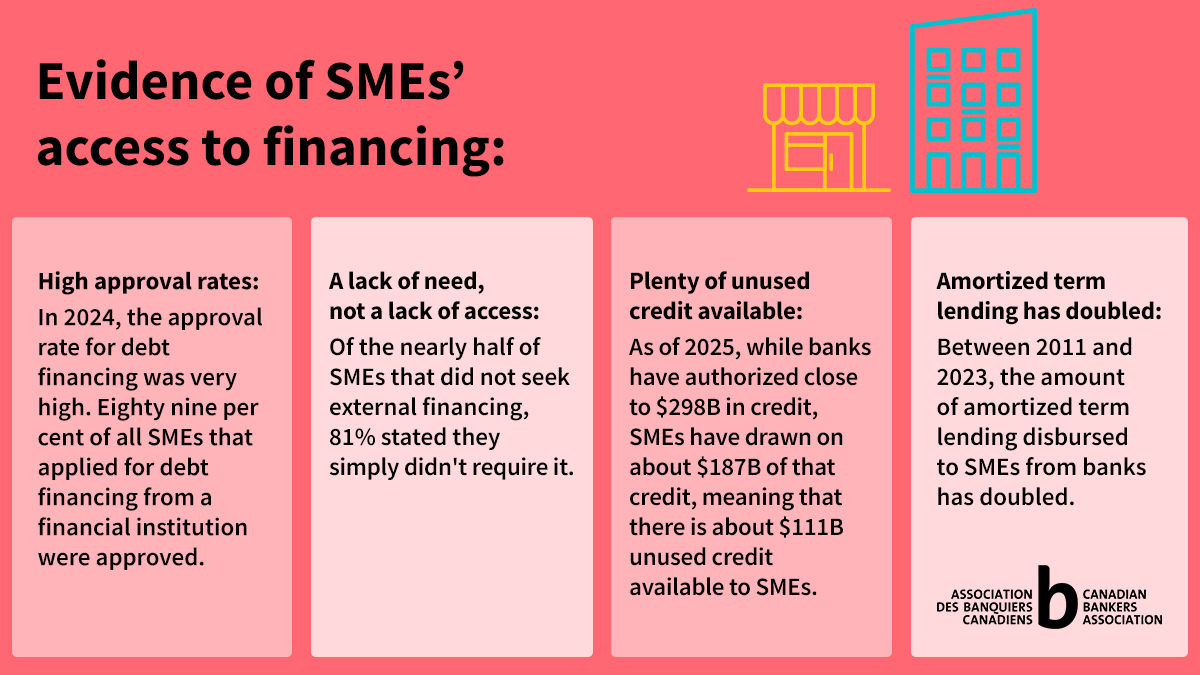
- High approval rates: In 2024, the approval rate for debt financing was very high. Eighty‑nine per cent of all SMEs that applied for debt financing from a financial institution were approved.3 For term loans specifically, it was 89%. Taking a longer‑term view, overall SME debt approval rates have remained well above 80% for more than 15 years
- A lack of need, not a lack of access: Of the nearly half of SMEs that did not seek external financing, 81% stated they simply didn't require it. Only a tiny fraction (2%) refrained from applying because they expected to be declined4
- Plenty of unused credit available: As of 2025, while banks have authorized close to $298B in credit, SMEs have drawn on about $187B of that credit, meaning that there is about $111B unused credit available to SMEs – up from $66B since the global financial crisis5
- Amortized term lending has doubled: Between 2011 and 2023, the amount of amortized term lending disbursed to SMEs from banks has doubled.6 While disbursements have declined since due to weak consumer spending and generally soft demand, uncertainty about economic conditions, taxes and regulations, it is expected to bounce back in 2025
 Concentration is not the same as lack of competition
A common critique of the Canadian banking landscape is the concentration of assets among the "Big Five" banks. However, the Organisation for Economic Co‑operation and Development (OECD) cautions that market concentration should not be confused with a lack of competitive intensity, which is what matters most for consumers and businesses.
Canada sits in the middle of the OECD pack, with ten countries having rates of concentration of over 90%, including Germany, Australia and New Zealand, and doesn’t factor in financial services that are provided by non‑banks offering substitutable products and services which is particularly true in Canada.
Competition is strengthened by the diversity of non‑bank players, not just by the number of large‑scale institutions:
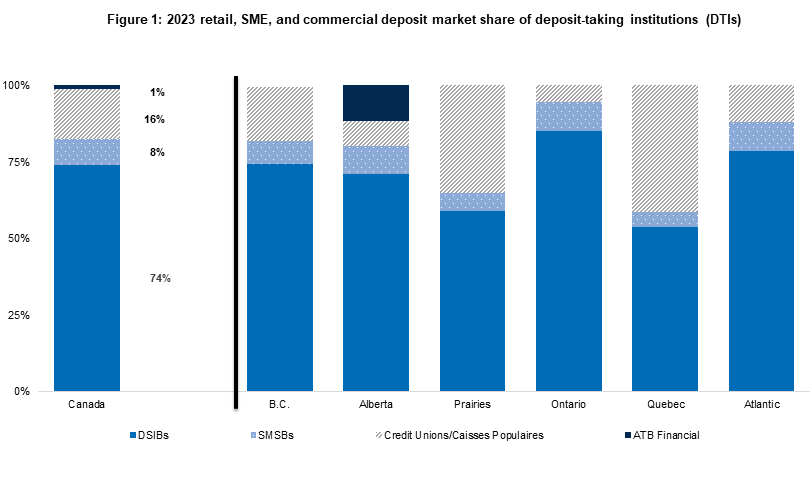
- The provincial powerhouses: Nearly 200 credit unions and caisses populaires, along with ATB Financial, provide local competition with national banks. When these institutions are considered, the adjusted concentration level in the deposit‑taking market declines considerably, particularly in western Canada and Quebec (see Figure 1)
- A broad spectrum of non‑bank lenders: Banks also compete with a wide range of specialized and government‑backed lenders, including the Business Development Bank of Canada (BDC), Farm Credit Canada (FCC), Agriculture Financial Services Corporation (AFSC), trust and loan companies, equipment financing firms, monoline and specialty lenders, mortgage investment corporations and private credit providers
- The fintech explosion: Over 5,500 fintech startups are currently competing in the Canadian marketplace, offering everything from revolving loans to credit cards
 Where we can improve
If the government wants to help benefit innovative lenders and SMEs, the focus should shift from "more competition" to modernizing regulatory frameworks. The issue isn't a lack of competition; it is a regulatory architecture that stifles scaling. These recommendations are contained within our comprehensive submission, Capital for Canada: Financing the growth and stability of small- and medium‑sized enterprises, to the Competition Bureau which goes into great detail on our analysis of the current lending landscape and includes our recommendations for improvement.
Regulators should refocus their efforts on several key pillars:
- Easing barriers to entry and growth: The path to becoming or expanding a small- and medium‑sized bank (SMSB) or federal credit union is currently too burdensome. The CBA supports efforts to facilitate entry for banks and federal credit unions and to find opportunities for clearer, more predictable and timely approval of new entrants to the banking sector. Budget 2025 announced the intention to raise the equity threshold for public holdings from $2 billion to $4 billion, allowing small players to grow larger before having to shift their ownership structure. We must also ensure provincial legislative frameworks and guidance do not inhibit the option of transitioning to the federal credit union framework
- Proportionality: Once SMSBs and federal credit unions are operating, they must be given the opportunity to thrive. Research has showed repeatedly that there are scale efficiencies to regulatory compliance. According to the C.D. Howe Institute, compliance currently consumes 28% of SMSB payrolls, double that of major banks. When done effectively, a proportional framework would allow small- and medium‑sized banks to grow into the level of prudential regulation that suits their overall level of significance or risk to the economy and their level of complexity without compromising on financial soundness and stability
- Align capital rules with real‑world lending risk: Budget 2025 announced important first steps to provide clarity in capital planning for Canada’s regulated financial institutions, including changes to capital requirements for SMSBs. Capital rules should reflect the actual historic performance of lending. Further changes can be made to the large banks’ capital adequacy framework to ensure larger banks are encouraged to continue supporting economic growth
- Strengthening coordination and incorporating growth considerations into regulatory decision‑making: As committed in Budget 2025, federal financial regulators should proceed with strengthening coordination and provide more predictable and transparent regulatory consultations and implementation schedules. Furthermore, the Department of Finance along with its financial regulatory partners should consider incorporating economic growth into their decision‑making through cost‑benefit and post‑implementation impact analyses
- Transitioning the Canada Small Business Financing Program (CSBFP): The CBA supports Budget 2025’s proposal to transition the CSBFP to the federal Business Development Bank of Canada as there is an opportunity to streamline the CSBFP to make it more nimble and flexible
- Expanding data sharing policy to include government entities including the Canada Revenue Agency (CRA): With taxpayer consent, allow CRA to digitally share tax documentation with banks and other financial institutions to enable the adjudication of credit applications and to help clients with their financial planning. This would help strengthen Canada’s position in the global digital economy, give Canadian businesses greater control over their data, and enable banks and other financial institutions to undertake their due diligence process much more quickly and efficiently
SMEs are already well‑served by a stable, safe, and competitive market. They would be better served by a regulatory system that prioritizes efficiency and growth.
Moving forward
The Canadian SME lending market is a high‑functioning, competitive environment where the vast majority of businesses get the funding they need. To make things even better, we should ensure that our regulatory system keeps pace with current and future needs.
By shifting the conversation from "access to credit" to "regulatory modernization," the Bureau could help to better position its study of competition in the financing of Canada’s small- and medium‑sized enterprises.
1 The CBA defines a small- and medium‑sized enterprise (SME) as having authorized borrowing under $5 million and defines small businesses as having authorized borrowing under $1 million.
2 Statistics Canada, Survey on Financing and Growth of Small and Medium Enterprises, 2023
3 ISED, Credit Conditions Survey, 2024
4 Statistics Canada, Survey on Financing and Growth of Small and Medium Enterprises, 2023
5 CBA Business Credit statistics
6 ISED, Biannual Survey of Suppliers of Business Financing