Article
Fast facts
- Digital banking has become the norm for Canadians young and old, with eight out of 10 (82 per cent) using digital channels (online and app) to conduct most banking transactions
- Nearly nine in ten Millennial (85 per cent) and Gen X (86 per cent) Canadians use digital channels to conduct most banking transactions
- This remains consistent across older generations, with over eight out of 10 of Baby Boomers (82 per cent) and almost eight out of 10 of Silent Generation (77 per cent) Canadians also using digital channels for most banking transactions
- Nearly nine out of 10 Canadians (88 per cent) reported using online banking in the last year, and almost half (45 per cent) say it is their most frequent banking method
- Mobile app banking continues its ascent as a most frequently used banking method, driven by a strong uptake across Gen Z (45 per cent), Millennials (47 per cent), and now Gen X (41 per cent)
- Nearly eight out of 10 Canadians (78 per cent) reported using an app to do their banking in the last year, up from four out of 10 (44 per cent) in 2016, and nearly four out of 10 (37 per cent) say it is their most common banking method
- Bank customers are very satisfied with their online and app banking experience, with satisfaction levels at 97 per cent for both methods, up from 93 per cent for online banking satisfaction and 73 per cent for app satisfaction in 2018
- Respondents reported using e-Transfers an average of 4.4 times per month in 2026, up from 2.1 times per month in 2018
- Nearly eight in 10 Gen Z (77 per cent) and over 6 in 10 Millennials (64 per cent) reported using tools offered by their bank to track and manage spending and budgeting
These and other findings form the basis of How Canadians Bank, a biennial study by the Canadian Bankers Association and Spark Insights that examines the banking trends and attitudes of Canadians.
Technology continues to drive changes in how Canadians bank
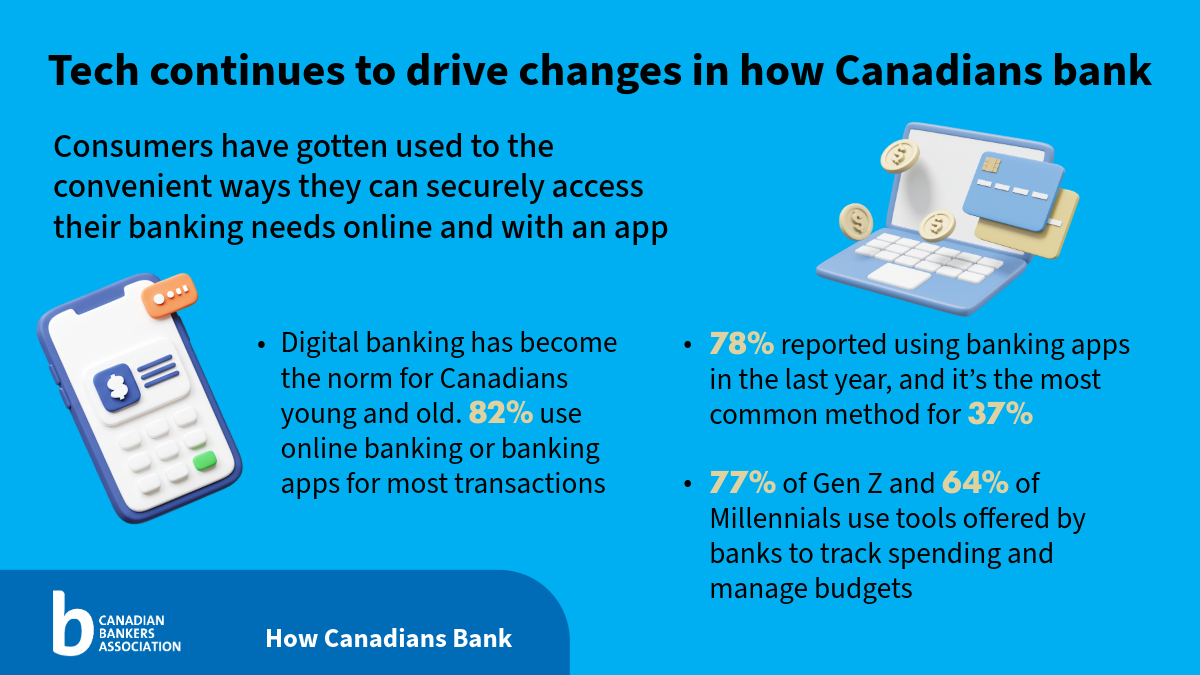
Consumers have gotten used to the convenient ways they can securely access their banking needs online and with an app.
Canadians can perform many banking tasks using their mobile devices through digital banking platforms that have incorporated robust security measures to protect users’ sensitive and personal information and transactions. As a result, online banking behaviours are migrating towards more app-based banking over time.
- Use of online banking increased to 88 per cent in 2026 from 76 per cent in 2016
- Banking app use saw an even larger increase, to 78 per cent in 2026 from just 44 per cent in 2016
The frequency of technology use in day-to-day transactions has also grown significantly.
- Canadians reported using tap and pay at retail stores an average of 13.5 times a month, up from 9.1 times a month in 2018
- They reported using tap and pay with a smartphone an average of 4.7 times per month, up from 3.3 times per month in 2018
- And they reported using e-Transfer an average of 4.4 times a month, up from 2.1 times in 2018
Beyond day-to-day transactions, nearly eight of 10 Gen Z (77 per cent), born between 1997 and 2012, and more than 6 of 10 Millennials (64 per cent), born between 1981 and 1996, reported using tools offered by their bank to track and manage their spending and budgeting.
While uptake is strong in younger generations, it is more moderate among Gen X, born between 1965 and 1980, with five of 10 (47 per cent) saying they use these tools, and less than four of 10 Baby Boomers (35%), born between 1946 and 1964, saying they use them.
Online banking is still the most common way people bank, but banking apps are increasingly popular
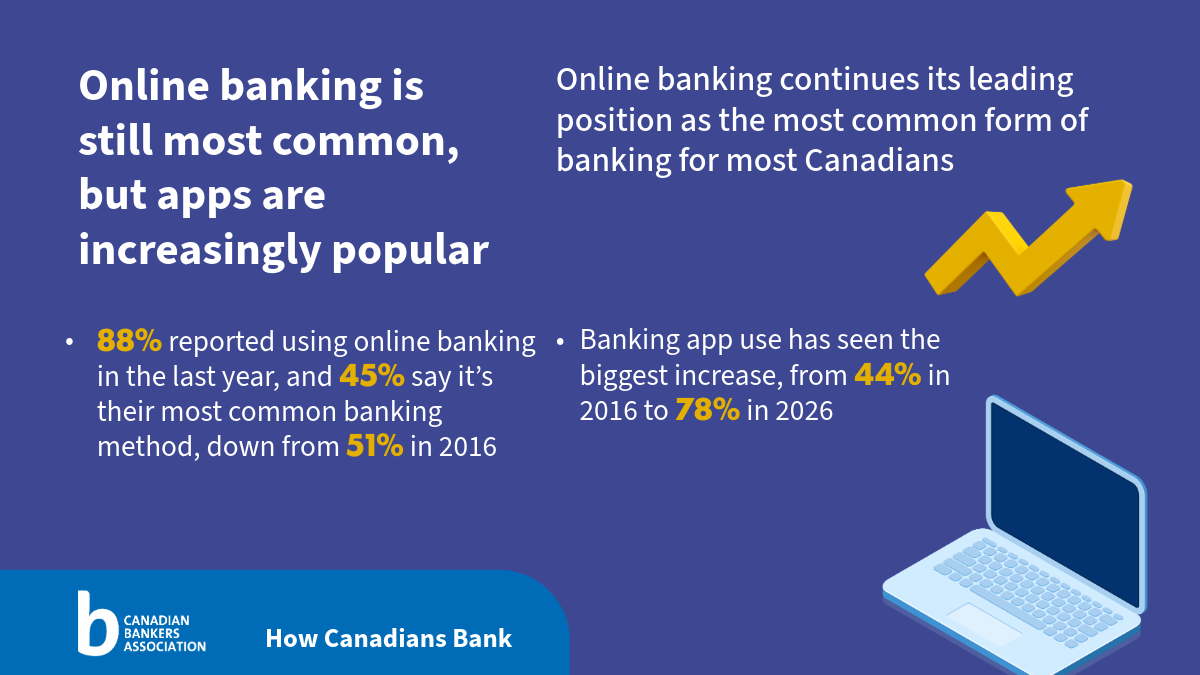
As banks continue to improve banking technologies, online banking continues its leading position as the most common form of banking for most Canadians, but consumers are shifting from online banking towards app-based banking.
- Almost nine of 10 (88 per cent) reported using online banking in the last year, and almost half (45 per cent) say online banking is their most common banking method, down from 51 per cent in 2016
- Almost eight of 10 (78 per cent) reporting using banking apps in the last year
- Almost four of 10 (37 per cent) say app-based banking is their most common method, up from just 17 per cent in 2016, and they say they access mobile banking apps an average of 9.6 times per month
- Online banking is the go-to channel for most banking transactions for more than six of 10 Baby Boomers (63 per cent) and seven of 10 Silent Generation Canadians (72 per cent)
- Banking apps are the preferred channel for most banking transactions with close to half of Gen Z (45 per cent) and Millennials (47 per cent)
- Apps are seeing strong uptake among Gen X Canadians as well, with four in 10 (41 per cent) using a banking app for most transactions
In-person branch banking still matters, but its role is evolving
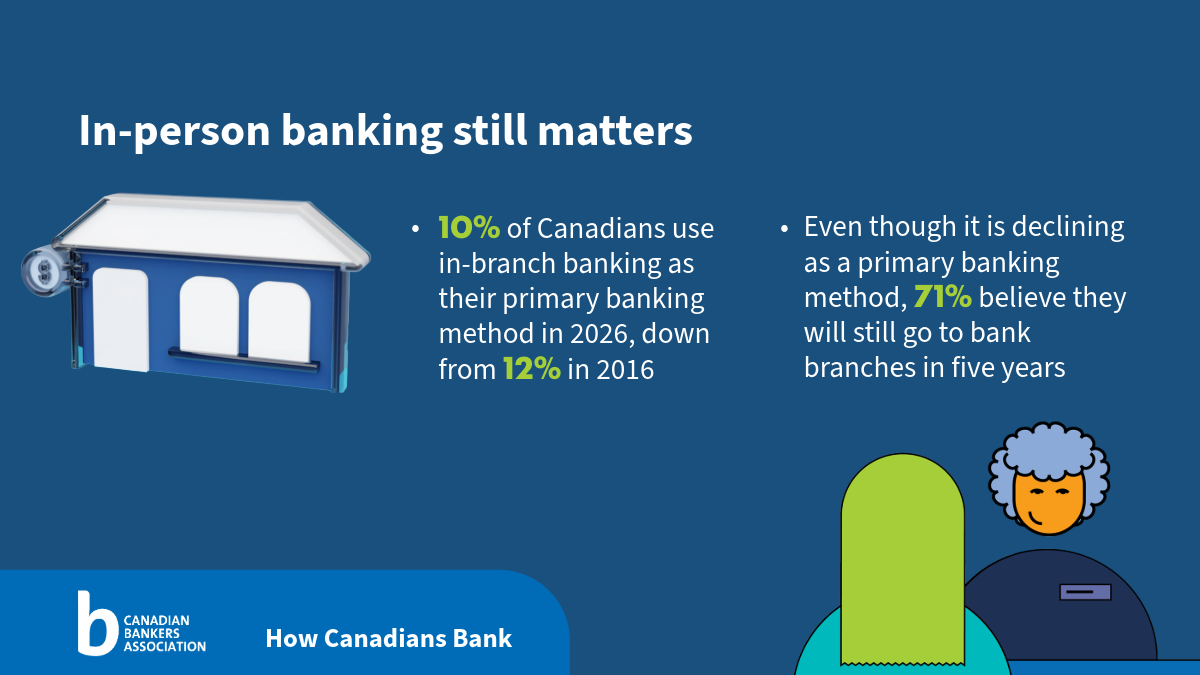
- Ten per cent of Canadians used in-branch banking as their primary banking method in 2026, down from 12 per cent in 2016
- Respondents reported visiting bank branches an average of 1.5 per month in 2026, down from 1.8 times in 2018
- 71 per cent believe they will still go to bank branches in five years
The decline in ABM usage
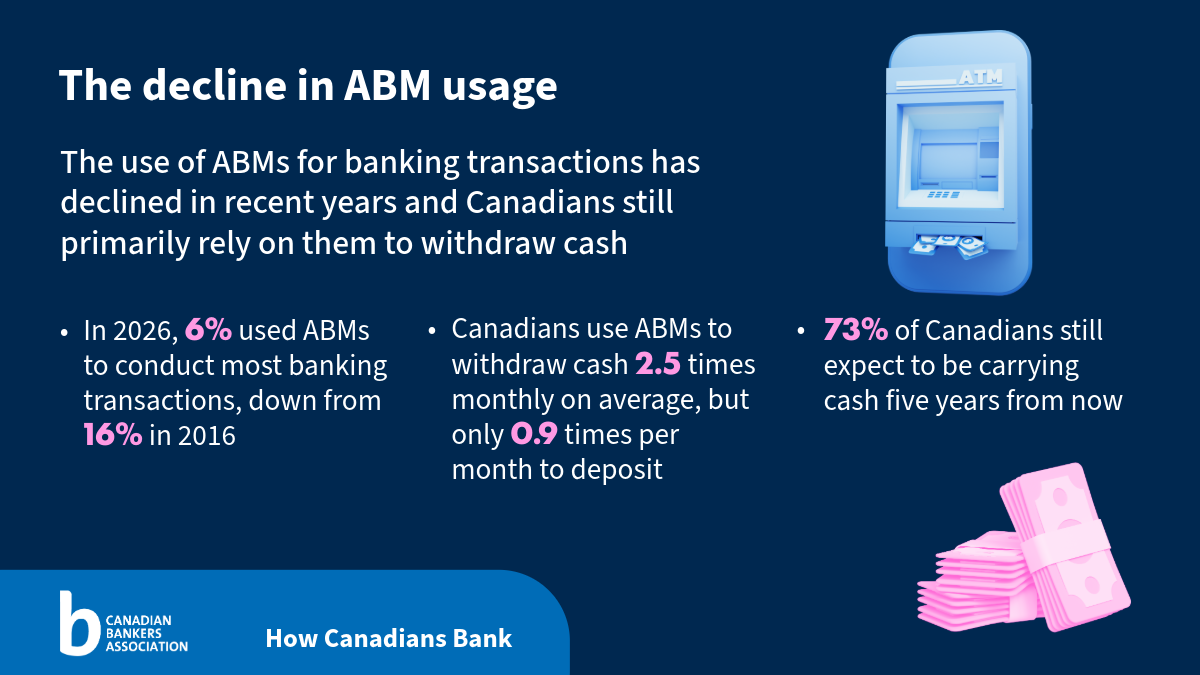
Although we have seen a decrease in the use of ABMs to conduct banking in recent years, Canadians still rely on ABMs primarily to withdraw cash.
- In 2026, only six per cent of those surveyed used ABMs to conduct most banking transactions, down from 16 per cent in 2016
- On average, Canadians use ABMs to withdraw cash 2.5 times per month, virtually unchanged compared to 2018, but only 0.9 times per month to deposit, down from 1.3 times in 2018
- 73 per cent of Canadians still expect to be carrying cash five years from now, pointing to the continued usefulness of ABMs
Cryptocurrency use, interest, and satisfaction is down or flat
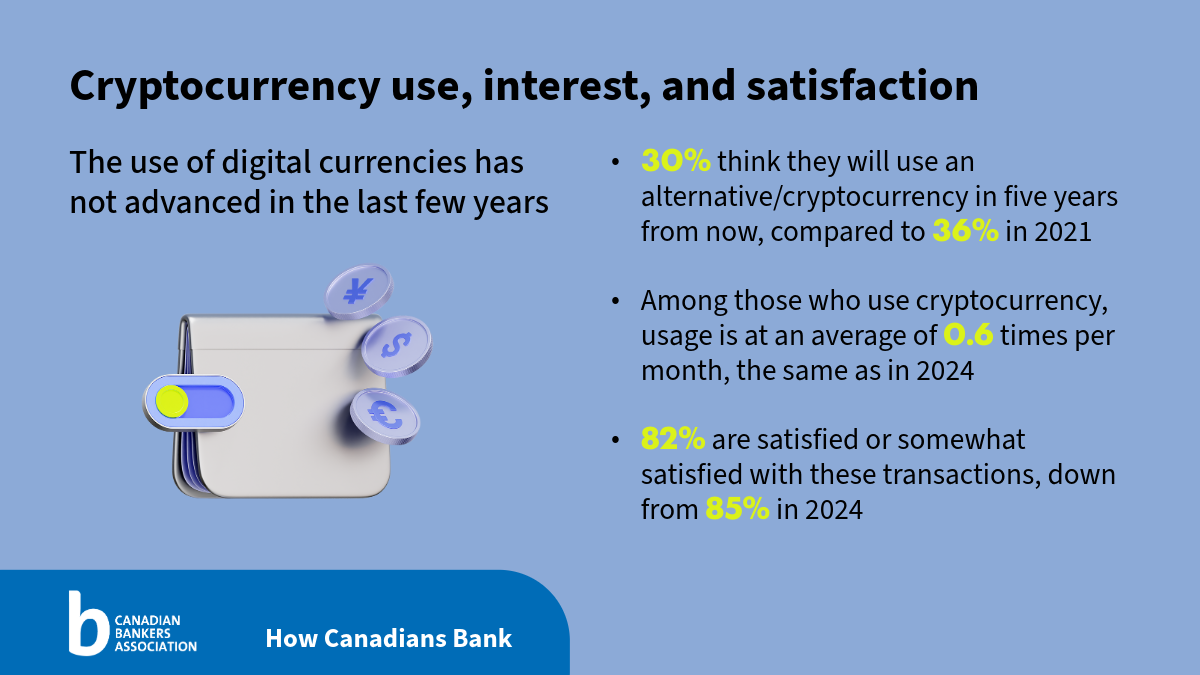
The use of and interest in cryptocurrencies has not advanced much in the last few years.
- Thirty per cent think they will use an alternative / cryptocurrency five years from now, down from 36 per cent in 2021
- Among those who use cryptocurrency, usage is at an average of 0.6 times per month, the same frequency as in 2021
- Also among those who use cryptocurrency, 82 per cent are satisfied or somewhat satisfied with these transactions, down slightly from 85 per cent in 2024
Looking forward five years
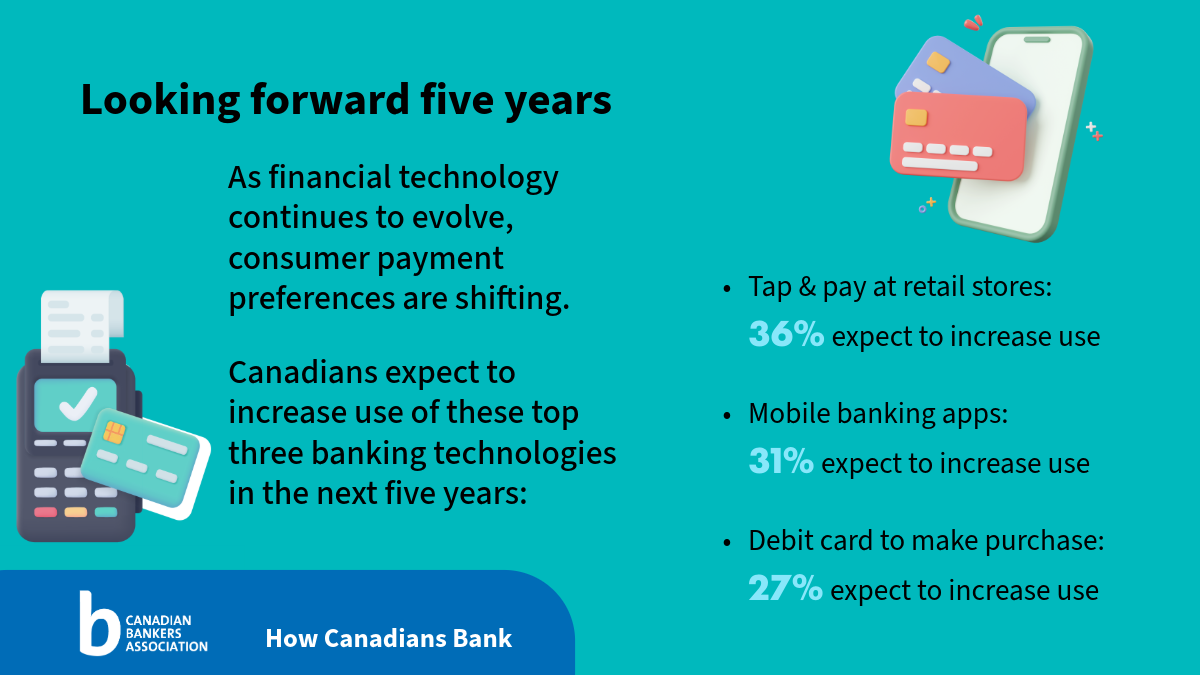
As financial technology continues to evolve, consumer payment preferences are shifting significantly. A growing number of people are embracing digital payment methods, with 25 per cent planning to increase their use of e-Transfers in the next five years. Credit and debit cards appear to remain a staple, as more than eight in 10 say they will be using them five years from now.
The percentage of people who think they will be using alternative / cryptocurrency in five years is 30 per cent, down slightly from 32 per cent in 2024. And a similar percentage think they will be using paper cheques in five years, at 29 per cent.
Also in the next five years, Canadians expect to increase their use of these top three banking technologies:
- Using tap & pay at retail stores: 36 per cent expect to increase their use
- Using mobile banking apps: 31 per cent expect to increase their use
- Using a debit card to make purchases: 27 per cent expect to increase their use
Methodology
The biennial survey was conducted by Spark Insights in March 2026. A total of 4,000 adults were surveyed online and results were weighted according to gender, age, region, education, and past federal vote to reflect Canada’s population. A comparable probability sample would have a margin of error of +/-1.8 per cent, 19 times out of 20.
Note:
Generation
Gen Z
Millennials
Gen X
Baby Boomers
The Silent Generation
Birth Years
1997-2012
1981-1996
1965-1980
1946-1964
1928-1945